Useful on day one — without pretending certainty
Tuwa starts with your profile and first logged sessions, then gets more personal as real data arrives. Recovery scoring, training load trends, and personal baselines all get better once you have real records — Tuwa does not fill that gap with fake precision.
From onboarding answers to your own baseline
Tuwa starts by building a training profile from your onboarding answers: sport context, current lifting rhythm, recent workload, and the kind of sessions you plan to log. That profile helps the workload model start organized, while readiness and verdicts stay conservative until enough real physiology and training data exist.
Day one
Tuwa collects the context it can honestly use: your training background, planned lifting pattern, wellness check-in, and any HealthKit data you permit. A no-data recovery state stays neutral instead of pretending to know your personal baseline.
First sessions
As you log workouts, Tuwa starts calculating session load from the work you actually did: exercises, sets, reps, weight, RPE, and reps in reserve. Those logs create the early acute-load picture.
As history accumulates
With consistent HealthKit readings, wellness check-ins, and logged sessions, Tuwa can compare more signals against your own recent trend — and the explanations become more specific to your physiology and training history.
The first workout starts the model
Training load tracking starts building from the first logged workout. The first session gives Tuwa real load data to store, and each later session makes the acute and chronic workload views more useful.
Serious athletes already have good intuitions about their own recovery — built from years of training, competition, and paying attention to how their body responds. Tuwa's cold-start approach respects that. Early on, it helps you structure the log and understand what is known, while leaving room for your judgment when the data is incomplete.
Why honesty matters
False precision is worse than acknowledged uncertainty. If an app tells you "your recovery score is 84" on day one with no physiological data behind it, that number is fabricated. Athletes who rely on it are training by fiction.
The payoff is practical: instead of acting confident before it has evidence, Tuwa lets your own records become the baseline. As HealthKit readings, wellness check-ins, and logged sessions accumulate, the explanations become more specific to your physiology and training history.
Common questions
Do I need weeks of baseline data before Tuwa is useful?
No. Tuwa is useful from day one because onboarding sets up your training profile and logged sessions immediately start building workload history. Readiness is more conservative: when personal recovery history is thin, Tuwa avoids pretending that a population baseline is your baseline.
What does day one actually look like?
Tuwa collects the context it can honestly use: your training background, planned lifting pattern, wellness check-in, and any HealthKit data you permit. Training load tracking starts building from the first logged workout.
What if I have little or no HealthKit history?
If recovery history is thin, the app avoids over-reading it; a no-data recovery state stays neutral instead of pretending to know your personal baseline.
Will early verdicts start trimming my plan?
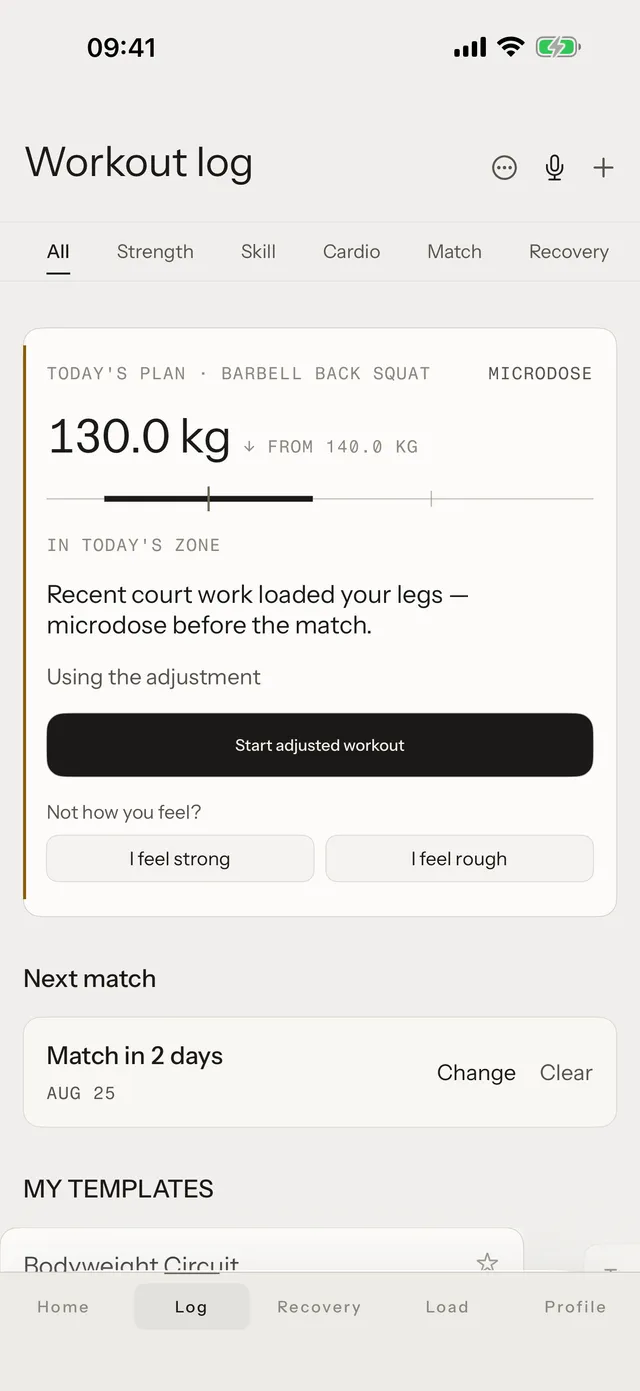
When the evidence is still too thin for a confident adjustment, the verdict can defer rather than trimming your plan on a guess.
Why not just show a recovery score anyway?
False precision is worse than acknowledged uncertainty. If an app tells you "your recovery score is 84" on day one with no physiological data behind it, that number is fabricated — and the disconnect eventually erodes trust in the tool entirely.
Let your own records become the baseline
Download Tuwa to bring your own plan, check today's verdict, and adjust the top set before you train.