Tuwa // the sports-science back room
Your plan.Made safeand optimal.
Tuwa is the sports-science back room for self-coached athletes. It reads your body — HRV, sleep, resting heart rate, training history — and modulates the plan you authored: today's numbers, a go / modify / hold verdict, and where your load is trending. It never writes your program.
Built for athletes who train sport skill and strength in parallel
 iOS 17+ · iPhone
 One decision, every day
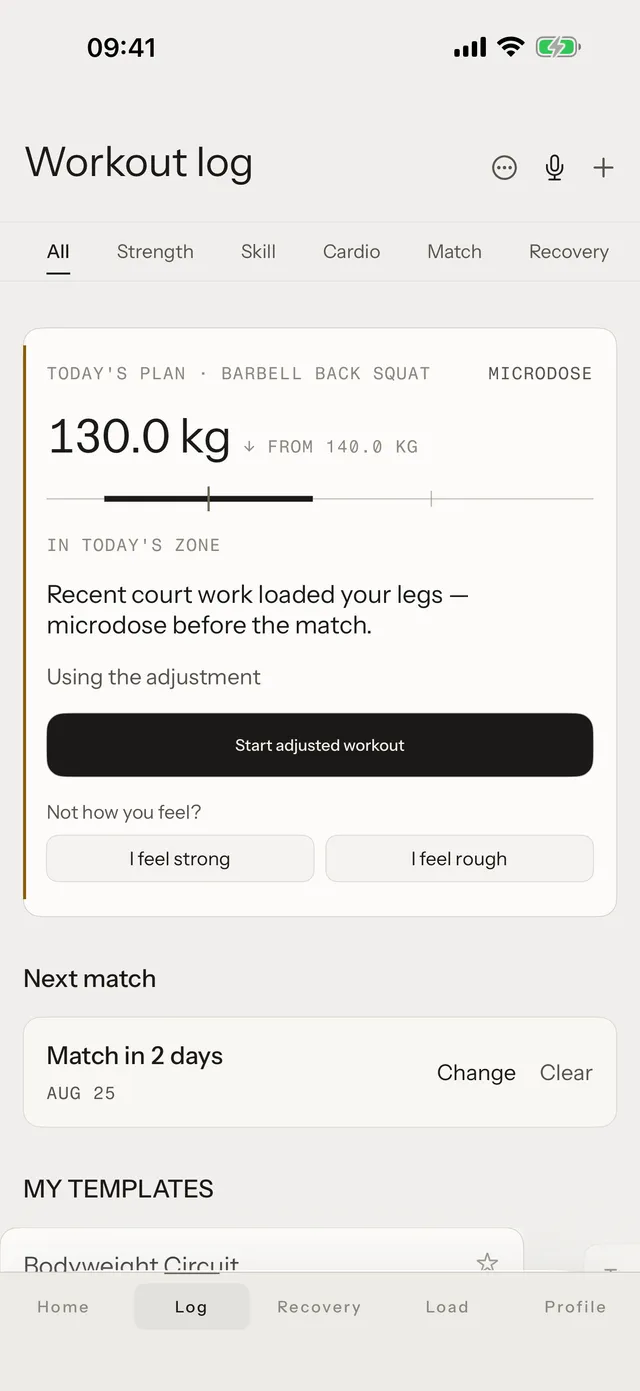
Every session starts with a verdict: go, modify, or hold. Tuwa turns this morning's physiology and yesterday's load into concrete number adjustments — drop the top set five percent, cap the conditioning piece, or take the microdose option and keep the pattern without the cost.
-
The verdict
Go, modify or hold — with the exact number changes for today's session, computed from your readiness and where you sit in your plan.
-
The strike zone
A live view of your acute-to-chronic workload ratio, held inside the band where adaptation outpaces injury risk.
-
The load trend
One fatigue budget across sport skill, strength and conditioning — and how it is trending, week by week.
No chat, no interpretation homework. A verdict, the numbers behind it, and the session you actually meant to do.
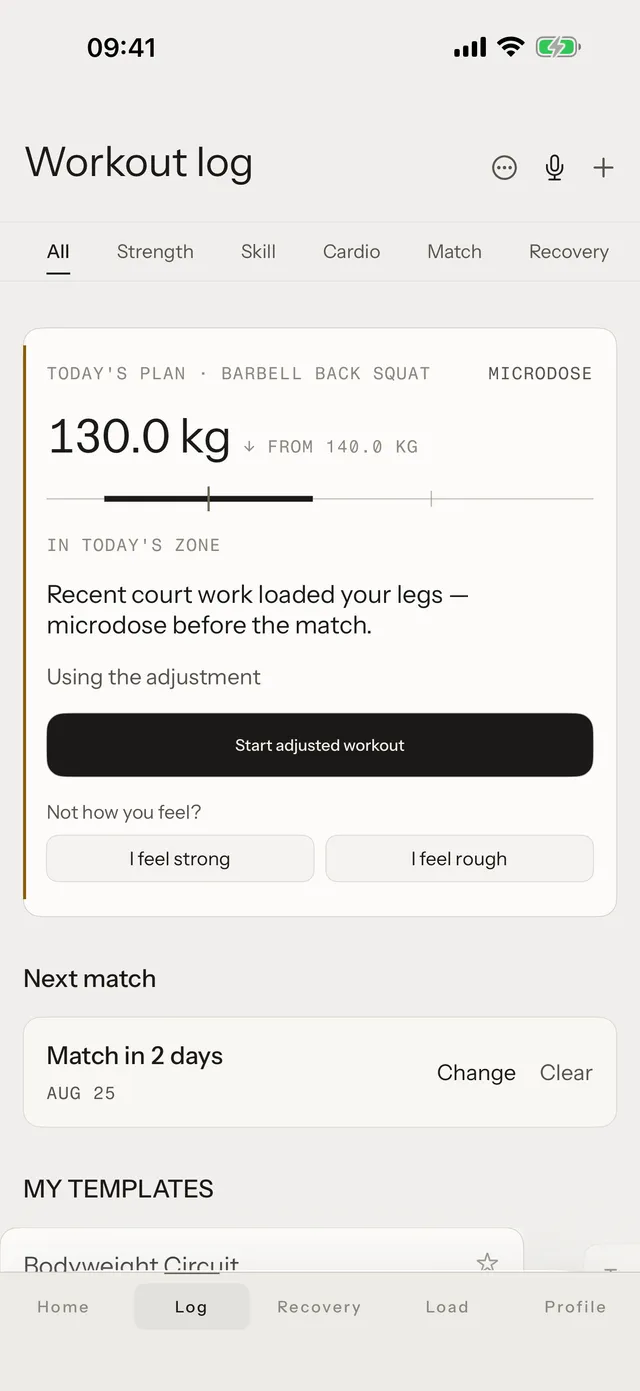
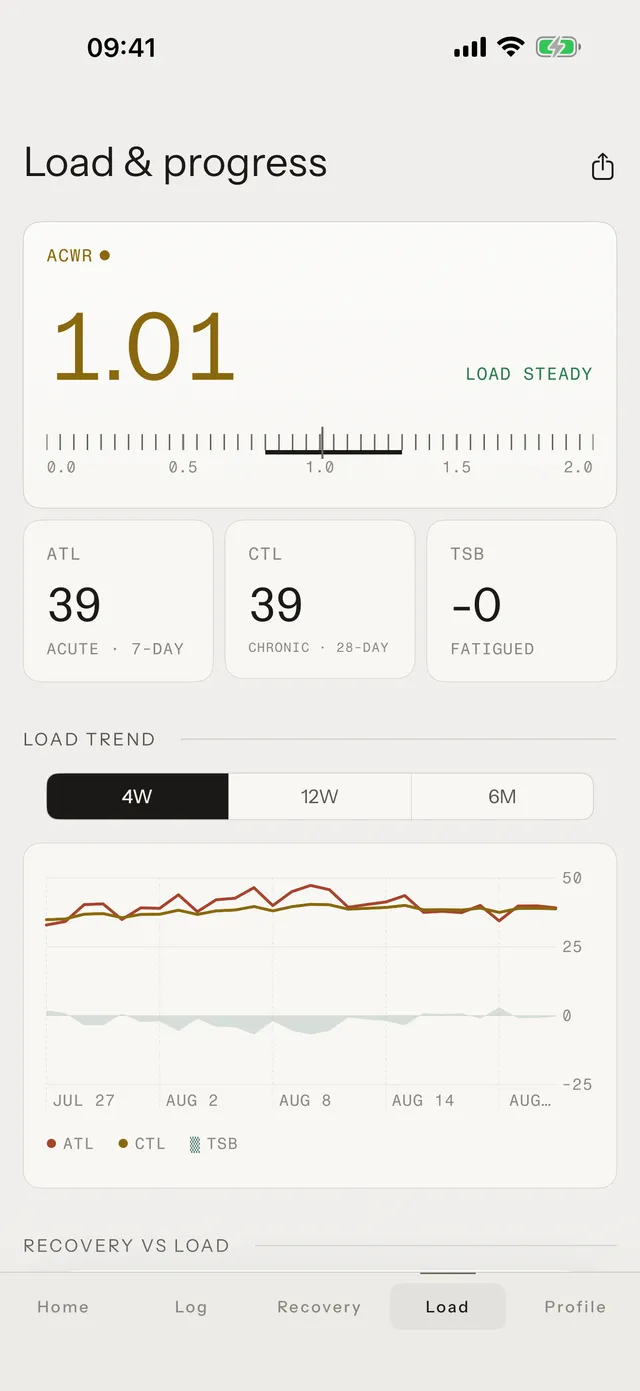
One fatigue budget
Sport skill, strength, and conditioning drain the same tank. Tuwa tracks them as one load — acute against chronic — and keeps the ratio inside the strike zone. When the trend points at overreach, you see it while there is still time to modify.
In the strike zone
The ratio compares the last seven days of load to the last four weeks. Tuwa's job is to keep it inside the strike zone.
The needle is fed by your history, not a population average. Same input, same answer — the engine is deterministic.
Zone names are always written out — colour is supplementary, never the message.
The whole system, one gesture
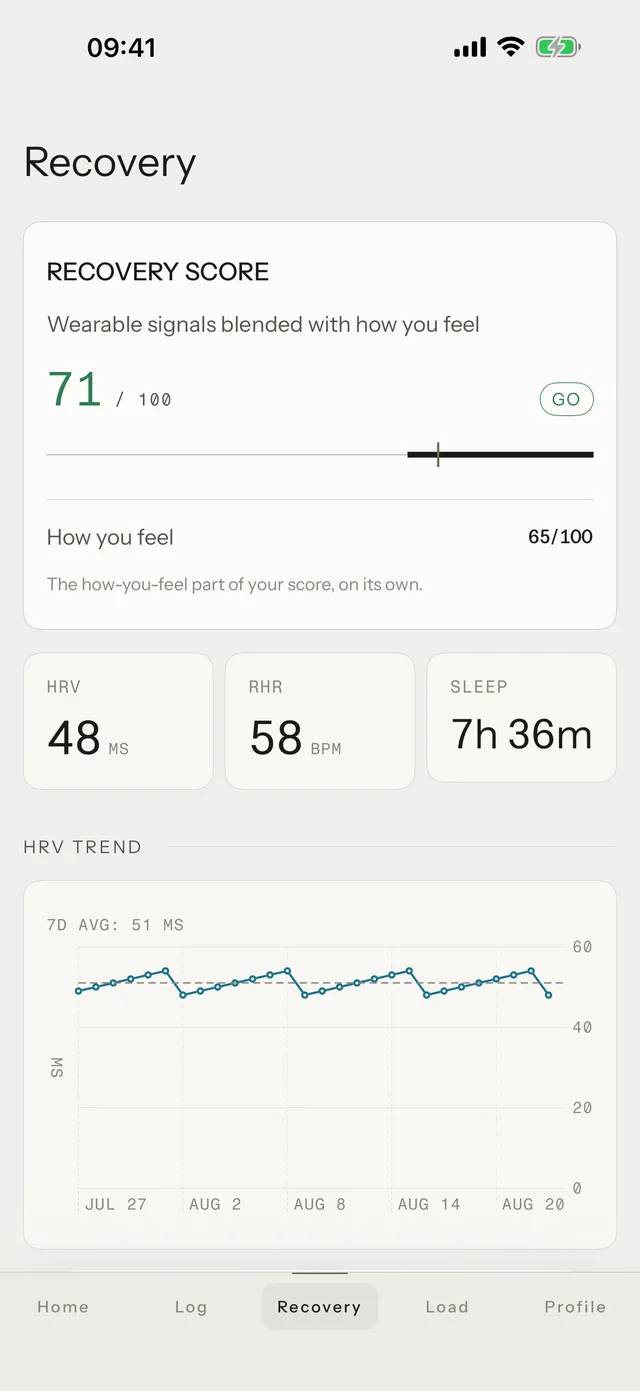
Recovery, today's decision, and the set you are in the middle of — one canvas each, no dashboard to assemble.
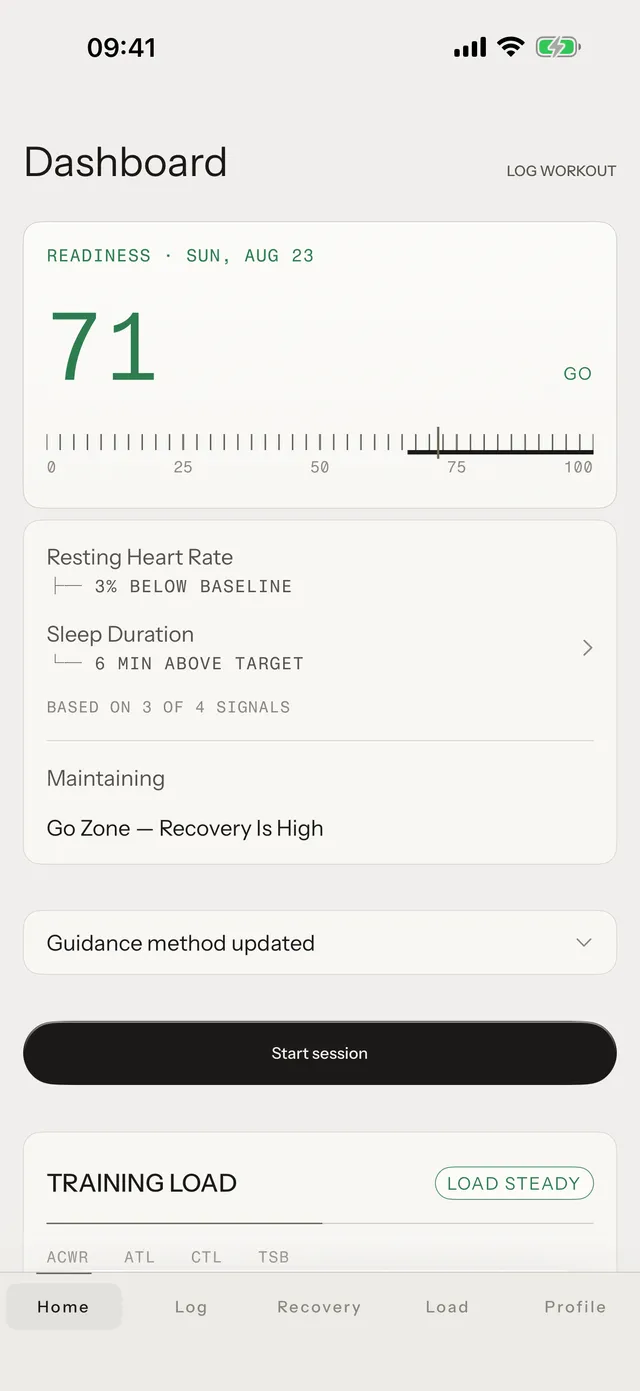
Type the session, or scrub it in
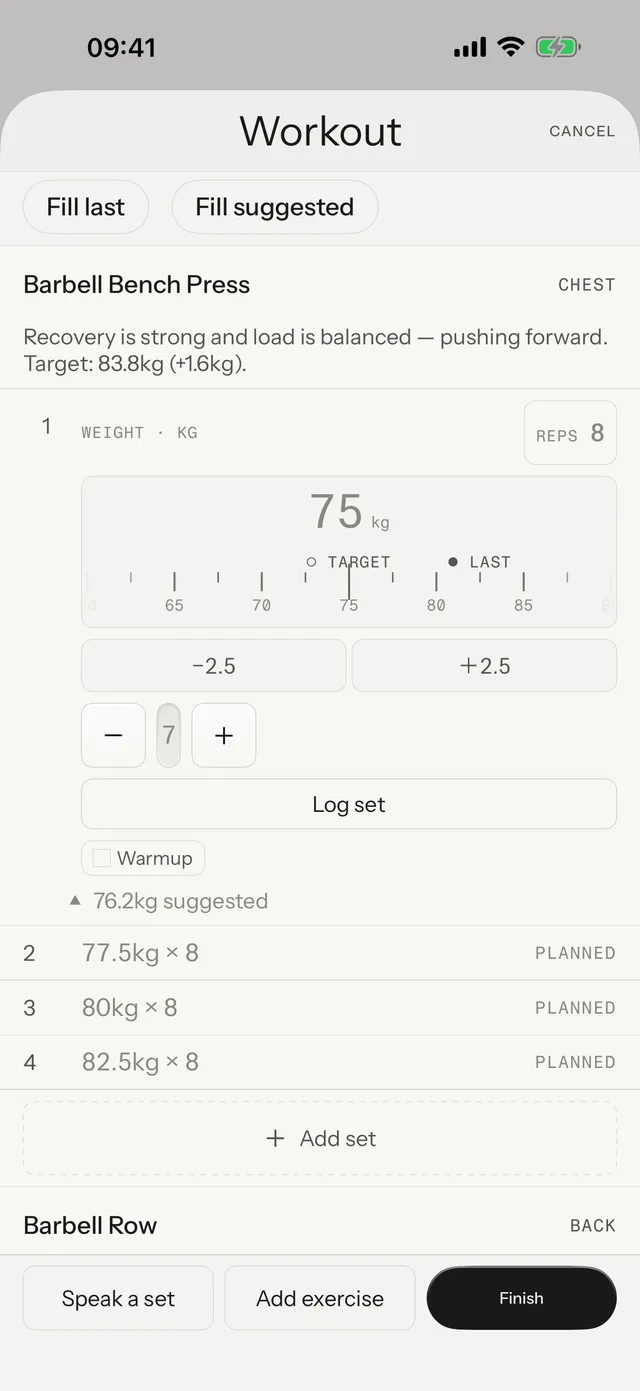
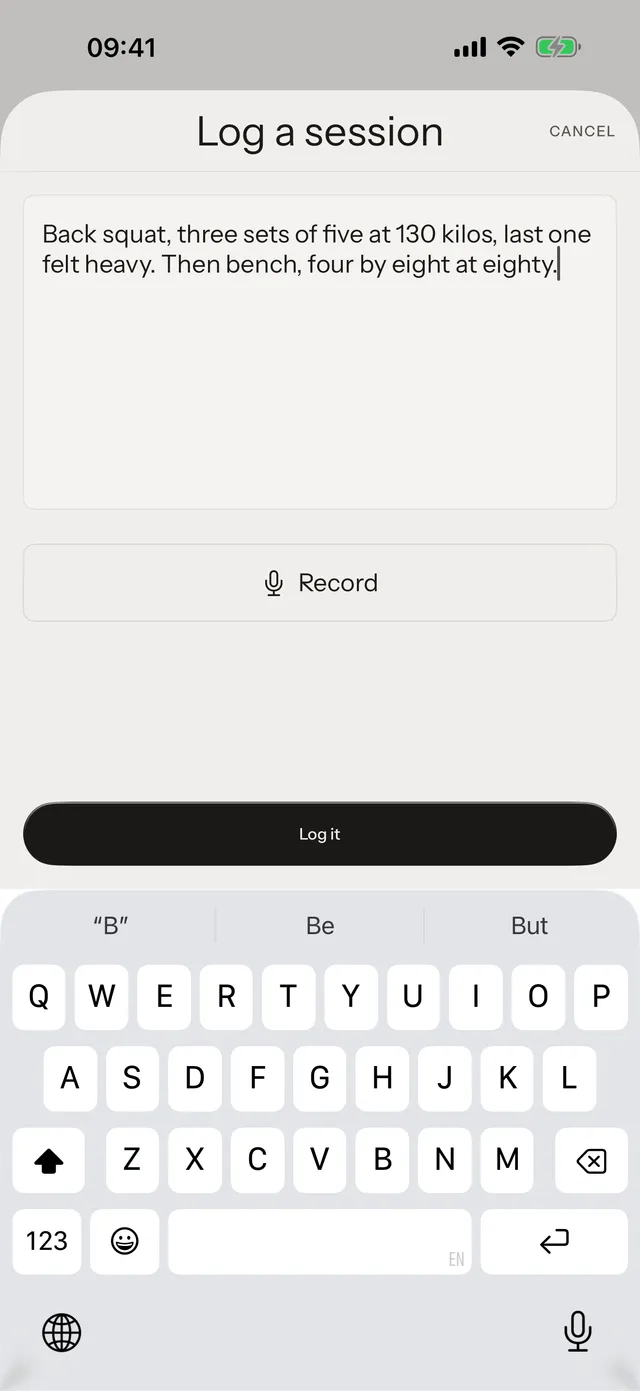
Type the workout the way you'd say it out loud, or log sets directly on the scrub scale — two doors, one record. Tuwa parses a typed description into an editable draft with every set filled in. Nothing saves until you confirm it, and any number is still yours to correct by hand.
- type it
- scrub it in
Manual entry never goes away. A 1,324-exercise movement bank sits behind a search-first picker, and the weight scale shows its full range before you touch it — your last set and today's target marked on the rule.
free on every tier · nothing saves until you confirm
Your baselines, drawn daily
Overnight HRV, sleep, and resting heart rate are scored against your own rolling baselines — not population norms — and compressed into one number with plain-language reasons. You don't get a dashboard to interpret. You get a score and the why.
every metric is scored against your own rolling baseline, not population norms
Here is what we believe,
and what would prove us wrong
Tuwa scores your sleep against a fixed target today. We are building one that adapts to the state you went to bed in. It is not finished — so here is the whole design, the weights, and the parts we are least sure of.
The target is yours, and you can see it
Your sleep target is learned from your own nights, not taken from a population average. And the weights behind the score are printed below — not a trade secret.
The score knows what the night had to do
Seven hours after an eighteen-hour day, after a match, and after a quiet Tuesday are three different nights. Same maths each time — the parts are just weighted differently.
It never leaves the phone
Your raw sleep, HRV and heart-rate readings stay in HealthKit on your device. Only the finished scores sync. This one is not a plan — it is how the app already works.
One set of weights, nudged — not a second algorithm
Every morning the app looks at what it already knows about yesterday — how long you were up, how hard you trained, how steady your sleep has been. That picks out which situations apply, and each one nudges the weights below. Every night stores what it saw and what it decided, so any score can be taken apart later.
simple arithmetic on your phone · no network · no new sensor
hours slept carries half the score — it is the best-evidenced part · deep and rem count for little, because a wrist only half-agrees with a sleep lab
we argued these numbers out — we did not fit them to data · logged as h-01
What changes, and how sure we are
| situation | when it applies | what changes | how sure we are |
|---|---|---|---|
| You were up too long | You had been awake far longer than usual before going to bed. | Hours and deep sleep matter more. Your target goes up, by 45 minutes at most. | backed · the size is our guess (h-02)Sleep pressure builds the longer you are awake — that much is settled. How much extra sleep it earns is our number, not the research's. |
| You trained hard | Yesterday was well above your normal for the last month. | Hours and deep sleep matter slightly more. Your target goes up by half an hour at most. | a guess (h-03)The only study we found that tested this directly found nothing. We kept it, wrote down what would make us delete it, and said so here. |
| Your rhythm just broke | You went to bed more than two hours off your usual time — the flight, the late game. | Being off-schedule counts for less, staying asleep counts for more, and deep and REM are trusted only half as much. | backed · the response is our guess (h-05)The first disrupted night really is the worst one. Easing off the schedule penalty is our answer to that, not a finding. |
situations only shift the weights — they never add a new ingredient to the score
Every guess, written down with the test that kills it
Anything in the score that no study backs goes on this list, next to the result that would make us change it. Nothing gets into the app without a line here — and if we cannot say what would prove a guess wrong, it does not go in at all.
| no. | what we are guessing | where it stands | what would change our mind |
|---|---|---|---|
| H-01 | The weights above are roughly right. | a guess · argued, not measured | Check each part against how people actually feel the next day, then re-fit once we have enough nights from enough athletes. |
| H-03 | A hard training day means you need up to half an hour more sleep. | a guess · the one test found nothing | If hard days and easy days show no difference, this comes out — from the situation and from the target. |
| H-07 | When you are well behind on sleep, hours matter more than sleep stages. | a guess · but well supported | Check whether deep and REM still tell us anything once you are in real deficit. |
| H-10 | Seeing your target move, and why, helps more than it worries you. | a guess · no study, just our call | Our own use, and what people tell us. If it reads as alarming, the whole layer goes quiet. |
Sleep pressure builds while you are awake. Borbély, Daan, Wirz-Justice & Deboer (2016), Journal of Sleep Research 25(2). We took the shape of it. We did not take any numbers.
Training shifts sleep, but only slightly. Kredlow et al. (2015), Journal of Behavioral Medicine 38. Small effects across 66 studies — which is why this one stays a guess.
Regularity is the middle of your night, not its start. Wittmann & Roenneberg (2006), Chronobiology International 23(1–2). That is the number we track.
Lost sleep adds up, and hours are what repay it. Van Dongen et al. (2003). The reason hours outrank sleep stages when you are behind.
The back room of a pro team — plan, physiology, and a decision — for athletes who coach themselves.
Your data stays on your phone
Tuwa reads HealthKit — it never writes to it — and raw health data never leaves the device. Only composite scores sync.
your plan, made safe and optimal