Describe the session
Type the workout the way you would tell a training partner. Tuwa turns the sentence into an editable draft with every set filled in, and nothing reaches your log until you confirm it. Free on every tier.
One line, one pipeline
Type the session the way you would say it out loud, or log each set directly on the scrub scale. Whichever you use, there is no command syntax to learn and nothing to phrase correctly.
"Back squat, three sets of five at 130, last one felt heavy" is a complete instruction.
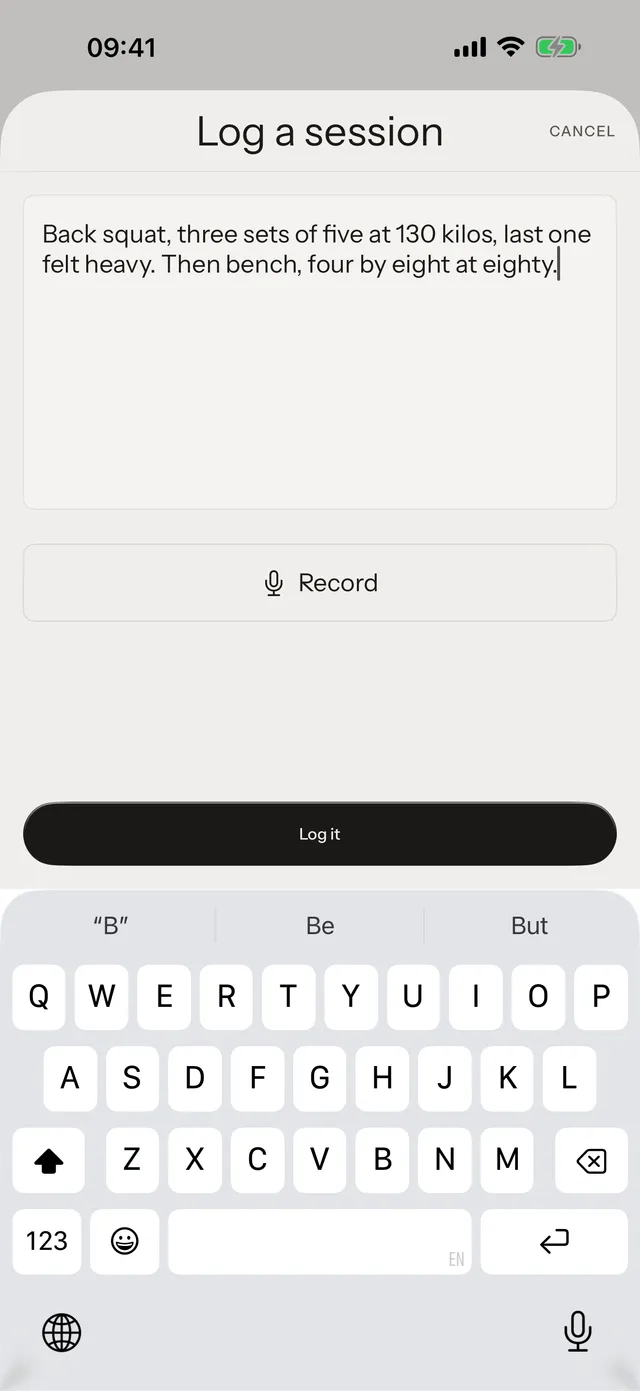
Back squat, three sets of five at 130, last one felt heavy. Then bench, four by eight at eighty.
One sentence. Seven sets, laid out and waiting for your eye.
Nothing saves itself
The parse does not write to your log. It opens the normal set-entry screen with the sets already in place, and every one of them is yours to correct: the weight scale shows its full range with your last set and today's target marked on the rule, and the rep stepper is where it always was.
This is the same discipline the daily verdict follows. Tuwa proposes, you confirm — and if the parse read "eighty" as the wrong lift, fixing it is one tap, not a re-typed sentence.
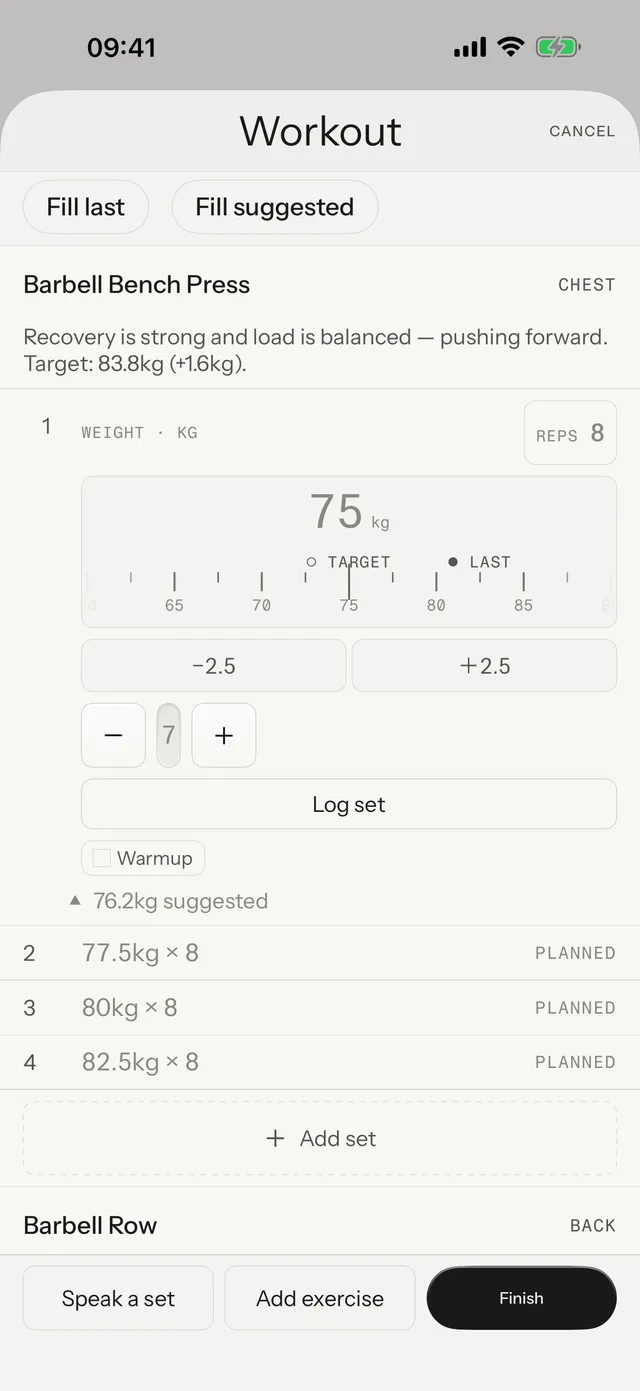
Manual entry never goes away. It is how you fix anything, and it is still the fastest route for one set between rounds.
One set at a time, without leaving the list
Inside a running workout you can type a single set as you finish it. The capture stays inline — the set list never disappears behind a sheet — and the set lands in the exercise you have open.
Nothing about the rest of logging changes. Templates carry forward, personal records are still detected, and the 1,324-movement bank is still one search away.
The sentence is processed on a server. Your physiology is not.
Turning a sentence into structured sets is not arithmetic a phone can do alone, so the workout text you type is sent to Tuwa's parsing service and processed by a third-party language model. Requests are tied to your signed-in account and capped by a daily quota.
That path carries the workout description and nothing else. Raw HealthKit data — HRV, resting heart rate, sleep — is read on your device and never leaves it, before this feature and after it. The full account is on the privacy policy.
Common questions
What do I actually type?
A plain sentence, the way you would tell a training partner: "back squat, three sets of five at 130, last one felt heavy. Then bench, four by eight at eighty." Tuwa reads exercise, sets, reps and load out of it and fills the draft in. You do not learn a command syntax, and there is nothing to phrase correctly.
Is voice logging still available?
No. As of v1.7.4, nothing in the app uses the microphone — not the workout log and not program import. Logging is typed description or direct entry; importing a training program takes pasted text or a PDF/photo instead.
Can it save something I did not do?
No. The parse produces a draft in the normal set-entry screen with every set laid out. Nothing is written to your log until you confirm it, and every number stays editable by hand until you do.
Does this replace manual entry?
It sits beside it. The weight scale, the rep stepper, templates and the movement bank are unchanged — manual entry is still how you correct anything, and it is still the fastest route for a single set between rounds.
Does it work mid-session, one set at a time?
Yes. Inside a running workout you can type one set as you finish it, or log it straight on the scrub scale, and it lands in the open exercise without covering the set list.
Where is the sentence processed?
The text you type is sent to Tuwa's parsing service and processed by a third-party language model to produce the draft. Requests are tied to your signed-in account and capped by a daily quota. Your raw HealthKit data — HRV, sleep, heart rate — is never part of this and never leaves your device.
Does it cost anything?
No. Text logging is free on every tier, including the free one.
Type it once, check it, keep training
Download Tuwa to log by text or by hand — and get today's verdict on the plan you already wrote.