Go, modify, or hold — with the why
Every session starts with a verdict: go, modify, or hold. Tuwa turns this morning's physiology and yesterday's load into concrete number adjustments — drop the top set five percent, cap the conditioning piece, or take the microdose option and keep the pattern without the cost.
No chat, no interpretation homework. A verdict, the numbers behind it, and the session you actually meant to do.
Three things, weighed together
Every morning, Tuwa reads the physiology you already collect through HealthKit: HRV, resting heart rate, and sleep. It pairs those signals with your training history, soreness, and match proximity, then evaluates the strength session you planned.
Your readiness
Overnight HRV, sleep, and resting heart rate are scored against your own rolling baselines — not population norms — and compressed into one number with plain-language reasons.
Where you sit in your plan
When you open the planned session, Tuwa has enough structure to answer the only useful question: is this still the right dose today? The exact number changes are computed from your readiness and where you sit in your plan.
Match proximity
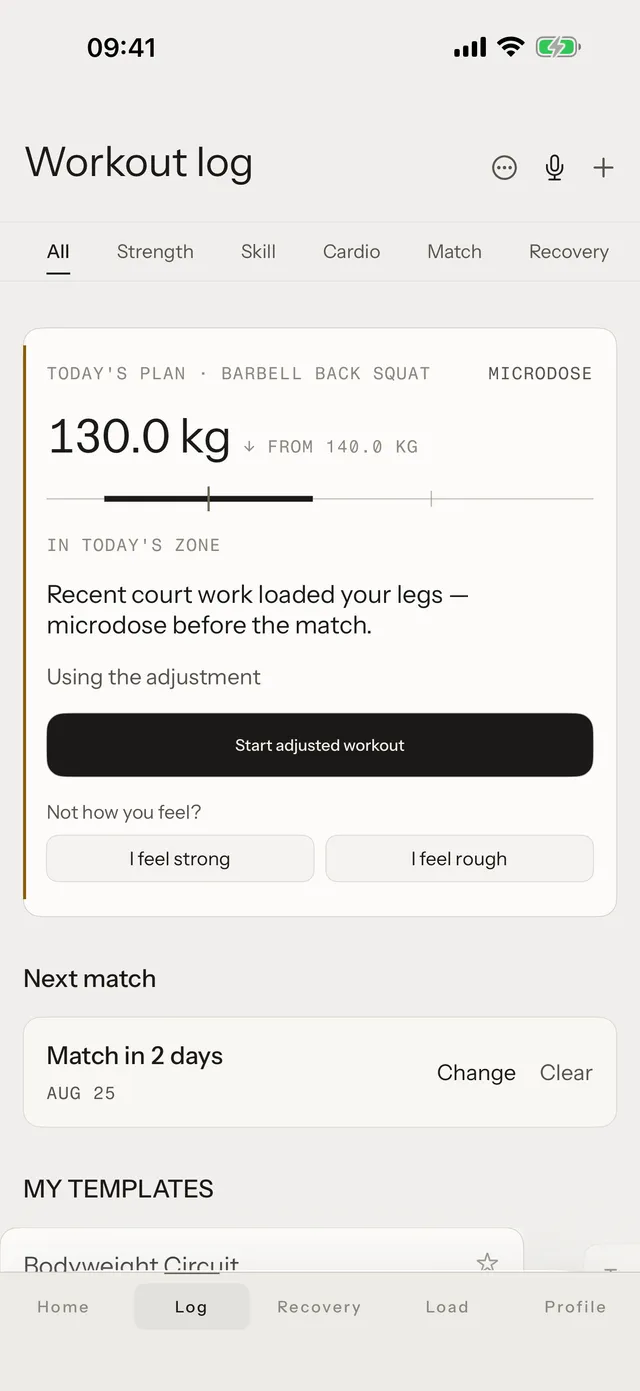
When a game is inside 48 hours, Tuwa frames the lift as a microdose: cap the top set, skip back-offs, and protect freshness.
An adjusted top set, not a lecture
The output is intentionally practical: go, modify, or hold, plus an adjusted top-set number and a one-line reason. For example: "Match Saturday — cap the top set, skip back-offs." You see the suggestion before warmups, while the session can still change.
- Go — the planned dose still fits the day.
- Modify — keep the session but trim the dose: cap RPE, reduce load, or microdose near a game.
- Hold — enough fatigue context to suggest delaying the hard part.
You confirm the call
A planned workout is a starting point, not a commandment. If match proximity, HRV, sleep, soreness, or recent load point down, Tuwa suggests a smaller dose and explains why. You confirm the change or run the original plan.
The choices carry equal visual weight in the app — accepting the adjustment and keeping your original plan sit side by side, and neither is styled as the right answer. A readiness tool should inform the decision, not talk your body into feeling worse than it is.
Same input, same answer — the engine is deterministic. And it never writes your program.
Common questions
Does Tuwa write my training program?
No. Tuwa does not write the program. It reads the strength session you authored, then helps you decide how hard to run it today. There is no generated program and no chat coach.
What feeds the verdict?
HRV, sleep, resting heart rate, training history, soreness, and match proximity — evaluated against the strength session you planned. Physiology is one part of the verdict, not the verdict itself.
What does "modify" actually change?
Modify means keep the session but trim the dose: cap RPE, reduce load, or microdose near a game. You get an adjusted top-set number and a one-line reason, before warmups, while the session can still change.
Do I have to follow the verdict?
No. None of the three is a command; the athlete confirms the call. You confirm the change or run the original plan.
What happens in the first week, before Tuwa knows me?
Readiness and verdicts stay conservative until enough real physiology and training data exist. When the evidence is still too thin for a confident adjustment, the verdict can defer rather than trimming your plan on a guess.
One decision, every day
Download Tuwa to bring your own plan, check today's verdict, and adjust the top set before you train.