One fatigue budget
Sport skill, strength, and conditioning drain the same tank. Tuwa tracks them as one load — acute against chronic — and keeps the ratio inside the strike zone. When the trend points at overreach, you see it days before you feel it.
Every session lands in one ledger
Every lift you log in Tuwa carries the details that matter for a readiness verdict: exercise, sets, reps, load, RPE, and reps in reserve. Basketball work gets its own context through match tier logging, so a casual pickup run does not count the same as a full match.
Tuwa uses exponentially weighted moving averages so recent sessions matter more than older ones. That keeps the load model responsive to a week with two games and a heavy lower-body day instead of anchoring the verdict to stale work.
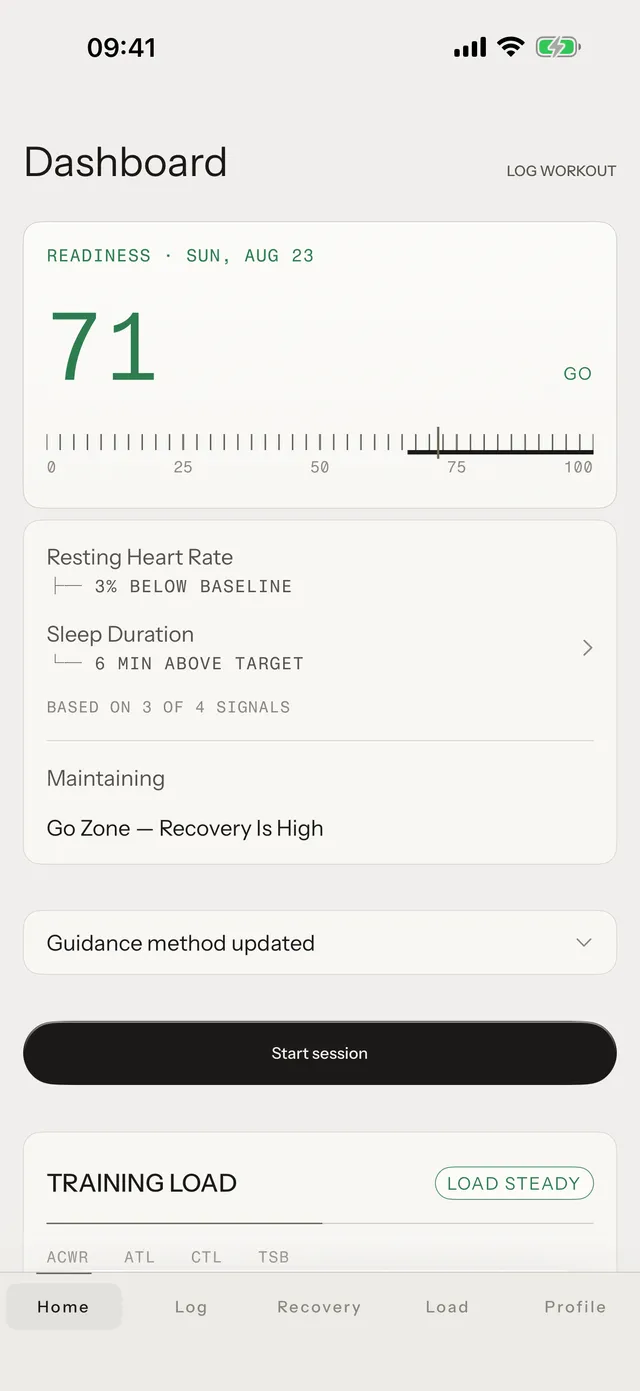
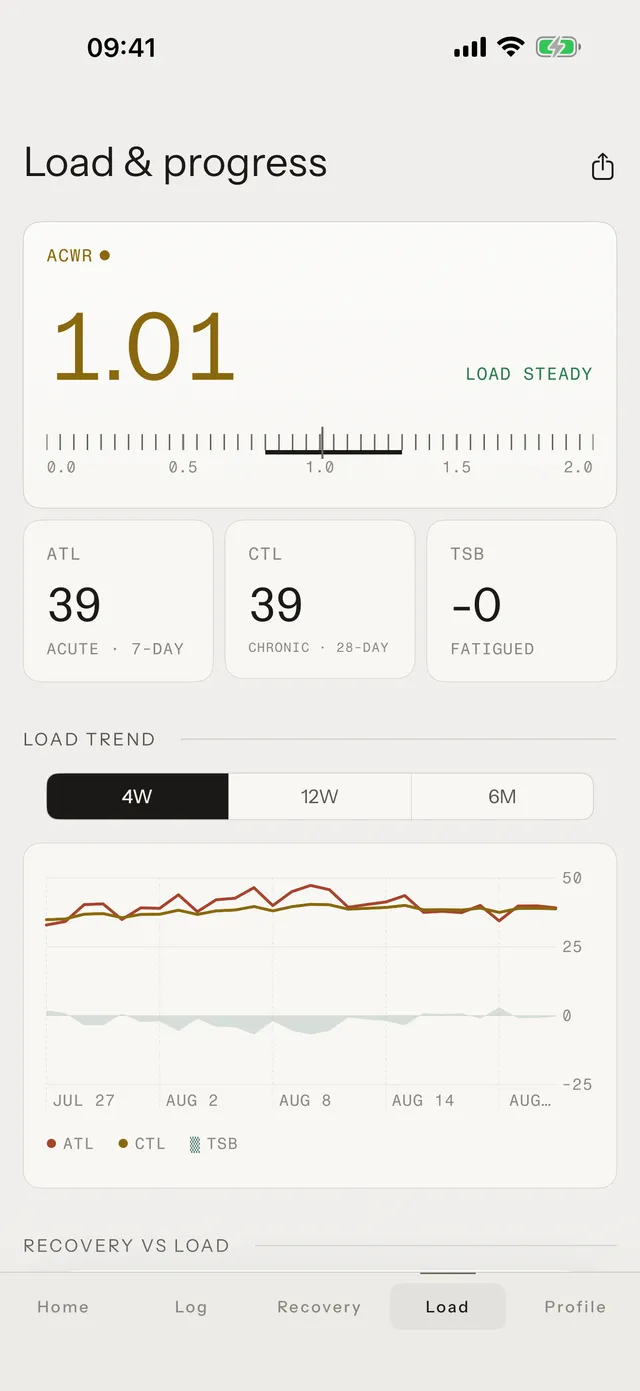
The needle is fed by your history, not a population average. Same input, same answer — the engine is deterministic.
The strike zone
The ratio compares the last seven days of load to the last four weeks. Tuwa's job is to keep it inside the strike zone. Below the range, you may be doing much less than your recent base. Above it, the current week may be asking for a bigger jump than your recent training supports.
- Under 0.8 — undertraining, room to build
- 0.8–1.3 — in the strike zone
- 1.3–1.5 — caution, trending hot
- Over 1.5 — danger, overreach risk
Zone names are always written out — colour is supplementary, never the message.
Tuwa treats the target range as planning context, not a universal safety rule. The acute-to-chronic workload idea compares recent workload with a longer baseline; the useful product lesson is not that one ratio predicts an injury. It is that sudden changes deserve attention before you add another hard lift.
One fatigue budget across sport skill, strength and conditioning — and where it is heading over the coming weeks.
Last night's game matters to today's squat
A whole-body wearable score can tell you that you are generally recovered or generally strained. It cannot say the useful thing for a basketball player who lifts: last night's game hammered your legs, today's squat readiness is down, and your bench is fine.
Tuwa can make that distinction because the plan and the log are in the same system. The court session, lower-body soreness, recent leg volume, and planned squat top set are evaluated together before the verdict is shown.
Common questions
What counts toward the fatigue budget?
Every lift you log carries exercise, sets, reps, load, RPE, and reps in reserve. Basketball work gets its own context through match tier logging, so a casual pickup run does not count the same as a full match. Sport skill, strength, and conditioning are tracked as one load.
What is the ACWR strike zone?
The acute:chronic workload ratio compares the last seven days of load to the last four weeks. Tuwa's job is to keep it inside the strike zone — roughly 0.8 to 1.3. Below the range, you may be doing much less than your recent base; above it, the current week may be asking for a bigger jump than your recent training supports.
Does the ratio predict injury?
No. The ACWR framework describes population-level workload associations, not individual guarantees or predictions; it informs decisions, it does not make them for you. Tuwa treats the target range as planning context, not a universal safety rule.
Why moving averages instead of weekly totals?
Tuwa computes loads with exponentially weighted moving averages, so recent sessions matter more than older ones. That keeps the load model responsive to a week with two games and a heavy lower-body day instead of anchoring the verdict to stale work.
Is the load view only about caution?
No. Tuwa tracks personal records and session history so the back-room view is not only about caution. If the verdict says go, you can train hard with the week in view. If it says modify, you still know what stimulus you preserved.
Stay in your strike zone
Download Tuwa to bring your own plan, check today's verdict, and adjust the top set before you train.