Readiness you can read
Overnight HRV, sleep, and resting heart rate are scored against your own rolling baselines — not population norms — and compressed into one number with plain-language reasons. You don't get a dashboard to interpret. You get a score and the why.
Your baseline, not the crowd's
Each morning, Tuwa pulls overnight physiological data from Apple HealthKit and combines it with a short wellness check-in to produce a single readiness number between 0 and 100. The inputs are not treated equally, and none of them is judged against a population norm — every signal is compared to your own recent trend.
HRV numbers vary enormously between athletes. What matters is whether your signals are above or below your own recent trend, and how that trend intersects with today's planned lift.
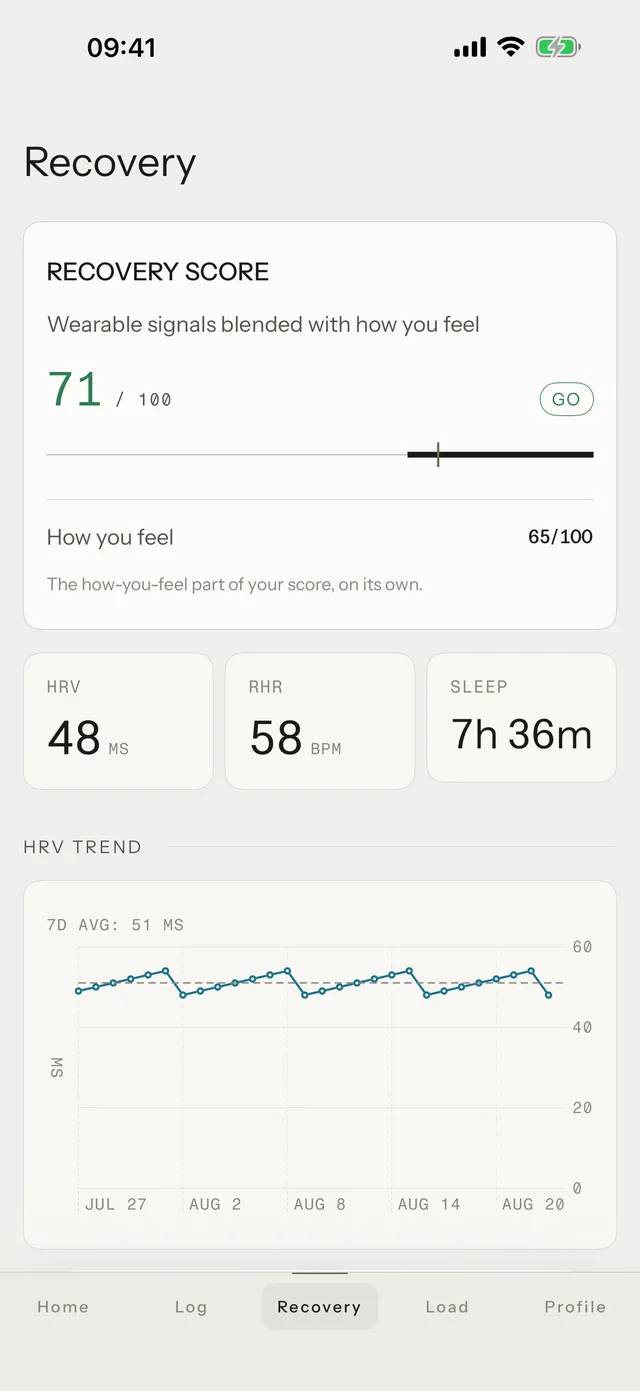
A score of 62 is never just a number: your HRV is tracking 8% below your recent baseline, your sleep ran short, but your resting heart rate is normal.
You see the reasoning, not just the verdict.
Physiology, blended with how you feel
The morning wellness check-in — where you rate soreness, energy, and stress — adds the context no wearable can measure. Those answers can override the physiology when, for example, you feel wrecked despite clean numbers.
HRV is also noisy. A poor night's sleep, a late game, or an unusually early alarm can affect a single measurement — which is exactly why Tuwa tracks trends rather than reacting to individual data points. Physiology is one part of the verdict, not the verdict itself.
Why HRV carries the most weight
Heart rate variability is the variation in time between consecutive heartbeats, measured in milliseconds. A perfectly metronomic heartbeat — every interval exactly the same — is actually a sign of stress. Healthy hearts show subtle beat-to-beat variation because they're responding to signals from the autonomic nervous system, which balances the sympathetic (fight-or-flight) and parasympathetic (rest-and-digest) branches.
When you're well-recovered, parasympathetic activity is dominant and HRV is higher. When you're stressed, fatigued, or fighting off illness, sympathetic tone increases and HRV drops. This is why HRV has become one of the most researched biomarkers in sports science over the past two decades — it's a window into your nervous system's current state.
Common questions
Which signals feed the score?
Tuwa reads the physiology you already collect through HealthKit — HRV, resting heart rate, and sleep — and pairs it with a morning wellness check-in where you rate soreness, energy, and stress. Every signal is compared to your own recent trend, not a population norm.
Why personal baselines instead of population norms?
HRV numbers vary enormously between athletes. An athlete with a resting HRV of 45 ms is not less recovered than one at 80 ms — the question is whether your HRV today sits above or below your own recent trend.
What if the numbers look fine but I feel wrecked?
The morning check-in is where your subjective read enters the model: you rate soreness, energy, and stress, and those answers can override the physiology when, for example, you feel wrecked despite clean numbers.
Does my raw health data leave my phone?
No. Tuwa reads HealthKit — it never writes to it — and raw health data never leaves the device. Only composite scores sync.
What does a low score actually change?
Physiology is one part of the verdict, not the verdict itself. The planned session, match proximity, soreness, and recent training history give the signal training context — and the output is a go, modify, or hold suggestion for the session you planned.
A score and the why
Download Tuwa to bring your own plan, check today's verdict, and adjust the top set before you train.